How Much Money Is Your Real Estate Agency Losing Without Knowing It?

Artem Kariavka
Founder and CEO of LivaRava
Technology entrepreneur with over a decade of experience in real estate technology, AI, and business automation. Former Co-Founder and CTO of Roomlr, Amsterdam, where we managed data for over 2 million vacation rental listings.
Your real estate agency may be losing valuable deals without even knowing it. Missed inquiries, forgotten follow-ups, disconnected systems, and delayed decisions can quietly turn promising opportunities into lost commissions.
These problems are particularly expensive for agencies managing high-value properties, complex negotiations, and relationships involving multiple stakeholders. A single missed step can affect a transaction worth millions of euros.
Before investing in more leads, ask how many opportunities your existing processes are already losing.
I've worked with real estate technology at very different scales — from Roomlr, an international vacation rental platform in Amsterdam, to business automation for luxury real estate in Monaco.
The markets are different. The operational challenges are often remarkably similar.

A Lost Customer Doesn't Always Look Like a Lost Customer
Imagine a potential buyer contacting your agency through WhatsApp about a property. They want more information and would like to arrange a viewing.
Your agent is busy. The message remains unanswered. Another inquiry arrives. A meeting runs longer than expected. The follow-up is forgotten.
Meanwhile, another agency responds, arranges a viewing, and starts the conversation.
Nothing dramatic happened. No system crashed. The opportunity simply disappeared.

Agencies know how many deals they close. They rarely know how many they could have closed.
When communication is distributed across personal email accounts, messaging applications, and individual employees, important relationships become difficult to manage consistently.
A customer relationship should belong to the business, not exist only in someone's memory or phone.
With LivaRava Business, we focus on connecting customer relationships, communication histories, and activities so that opportunities are easier to identify and manage.
What Can a Missed €3 Million Deal Really Cost?
Consider an illustrative scenario.
An agency is negotiating the sale of a property valued at €3 million. The buyer is interested, but several actions remain: additional documents, a follow-up call, coordination with the owner, and confirmation of the next meeting.
One document is delayed. A follow-up isn't scheduled. The buyer waits for an answer and eventually continues negotiations with another agency.
At an illustrative commission rate of 3%, the potential commission on that transaction would be €90,000. Actual commissions depend on the market and agreement.
A missed follow-up may take only seconds to prevent. A lost transaction can represent tens of thousands of euros in potential commission revenue.
Now imagine a connected CRM with an AI-powered assistant.
Instead of relying entirely on memory, employees can receive timely reminders, identify pending actions, retrieve customer context, and recognize situations requiring immediate attention.
Depending on available integrations and configured workflows, the system can help monitor follow-ups, coordinate appointments, and support the next appropriate action.
AI cannot guarantee that every transaction will close. But a properly designed system can reduce the risk of preventable mistakes and missed opportunities.
The objective is to help real estate professionals act at the right time, with the right information.
Your Business Has Data. But Does It Have Knowledge?
Most real estate agencies already use specialized software, CRM applications, email, messaging services, calendars, and spreadsheets.
The problem isn't necessarily the quality of these tools. It's the lack of meaningful connections between them.
When a customer contacts your agency, can your employee immediately understand:
- Who is this customer?
- Which properties interest them?
- What was discussed previously?
- Which documents or actions are pending?
- What should happen next?
If answering these questions requires opening several applications and contacting colleagues, the information exists, but it isn't working effectively for your business.
Having information is not the same as being able to use it when it matters.
This distinction is fundamental to LivaRava Platform.
We connect business information, relationships, APIs, and communication channels to make relevant knowledge easier to access and use.
The platform supports integrations involving email, WhatsApp, Telegram, Slack, and calendars across Google, Microsoft, and Apple, depending on available interfaces and integration requirements.
Connecting ImmoToolBox with CRM and AI
Real estate agencies shouldn't have to replace their existing software simply to benefit from better customer management and automation.
ImmoToolBox is a practical example of how specialized real estate software can become part of a connected business environment.
With LivaRava Platform, property information from ImmoToolBox can be connected to CRM workflows, customer relationships, communications, appointments, and AI-assisted processes, subject to available integration interfaces.
The same approach can extend to other real estate systems, including onOffice, FLOWFACT, Propstack, Apimo, Reapit, and Propertybase.
Integration requirements vary, but the principle remains simple: connect property information with inquiries, customer conversations, scheduled viewings, and follow-up activities.
Your agency doesn't necessarily need another real estate system. It needs its existing systems to work better together.

Security & Confidentiality: Protecting Valuable Client Relationships
In high-value real estate, client information represents more than operational data.
It includes private negotiations, financial details, personal relationships, and trust built over many years.
When this information is scattered across personal messaging accounts, spreadsheets, and individual devices, agencies risk losing control over sensitive business information.
A connected business system should address several important principles:
- Control over Client Data: Structured information and access permissions based on employee responsibilities.
- Connected Communication History: Relevant interactions preserved within managed business workflows.
- Reduced Human Error: Less unnecessary copying, forwarding, and manual handling of sensitive information.
- Confidentiality by Design: Privacy and access requirements considered when designing processes.
- Protection of Transactions: Appropriate handling of client identities, financial information, and negotiations.
- Controlled Communications: Less dependence on personal accounts and informal information-sharing practices.

These principles become especially important when transactions involve buyers, sellers, agents, lawyers, and external service providers.
With LivaRava Platform, we consider information architecture, access management, and confidentiality requirements when designing connected business systems.
The appropriate controls depend on the applications involved, their technical capabilities, legal requirements, and operating procedures.
The goal is to make the right information available to the right people, at the right time, under the right conditions.
Why Growth Can Make an Agency Less Efficient
There is an interesting paradox in real estate business growth.
More customers and transactions should create more value. But they also increase communication, coordination, and administrative complexity.
Without structured processes, agencies become increasingly dependent on individual employees.
Managers spend more time controlling operations. Agents spend more time searching for information. Important decisions take longer.
Eventually, hiring more people appears to be the only solution.
Sometimes it is. But sometimes the real problem is that existing processes were never designed to support growth.
The same applies to marketing. Generating more leads doesn't necessarily create more revenue if inquiries disappear between advertising channels, communication tools, and sales activities.
LivaRava Platform supports integrations with search engines, social networks, AI services, and digital marketing channels, providing a foundation for connecting customer acquisition with business operations.
Before investing in more advertising, employees, or software, understand where your existing processes are losing opportunities.
Roomlr: Managing Millions of Properties with AI Before the AI Boom
My experience with artificial intelligence in real estate started long before ChatGPT and the current wave of generative AI.
Back in 2012–2014, we were already applying intelligent information-processing technologies to organize and manage large volumes of real estate data.
In 2013, I co-founded Roomlr in Amsterdam and worked as its CTO.
We were building an international vacation rental search platform in a market where Airbnb was rapidly expanding.
The first prototype was developed during an intensive 48-hour hackathon. What began as an experiment evolved into a much larger technology business.
Roomlr aggregated and managed information for more than 2 million vacation rental listings worldwide.
Our work involved scalable architecture, data processing, synchronization, intelligent information management, search technologies, APIs, and web and mobile applications.
At that scale, manual information management wasn't a realistic option.
We needed technology capable of processing large datasets, identifying relationships, and keeping information useful.

This experience taught me an important lesson.
The challenge isn't simply collecting large amounts of information. It's making that information accurate, accessible, and useful.
Monaco: A Different Market, Similar Challenges
More recently, we've been working with a luxury real estate agency in Monaco.
This is a very different environment. The priority isn't managing millions of property listings.
It's managing valuable customer relationships, property information, and daily operations with greater precision.
Our work has included establishing CRM infrastructure, organizing customer and property databases, connecting lead capture, and integrating an AI assistant into the CRM environment.
Property information can become part of connected workflows while specialized real estate applications continue performing their original functions.
Consider what this means in daily operations. An agent may be handling several high-value transactions at once, each involving conversations, appointments, documents, and decisions.
Instead of manually checking multiple systems to understand what requires attention, an integrated AI assistant can help bring relevant customer context, outstanding tasks, and important next steps into focus.
For example, a buyer requests additional information after a property viewing. The agent has several other meetings scheduled that day. A properly configured assistant can help identify the pending follow-up, highlight the relevant conversation, and remind the agent to take action.
The practical value isn't simply answering questions faster. It's reducing the mental and administrative burden of keeping track of everything while ensuring that important activities are less likely to be overlooked.
This can substantially improve operational efficiency, allowing agents to spend more time building relationships, negotiating, and closing transactions rather than searching for information and coordinating routine activities.
An effective AI assistant doesn't replace the real estate professional. It helps the professional stay focused on the relationships and decisions that generate business value.
The broader direction includes conversational access to business information, messaging integrations, scheduling, and further workflow automation. These capabilities require their own implementation and integration work.
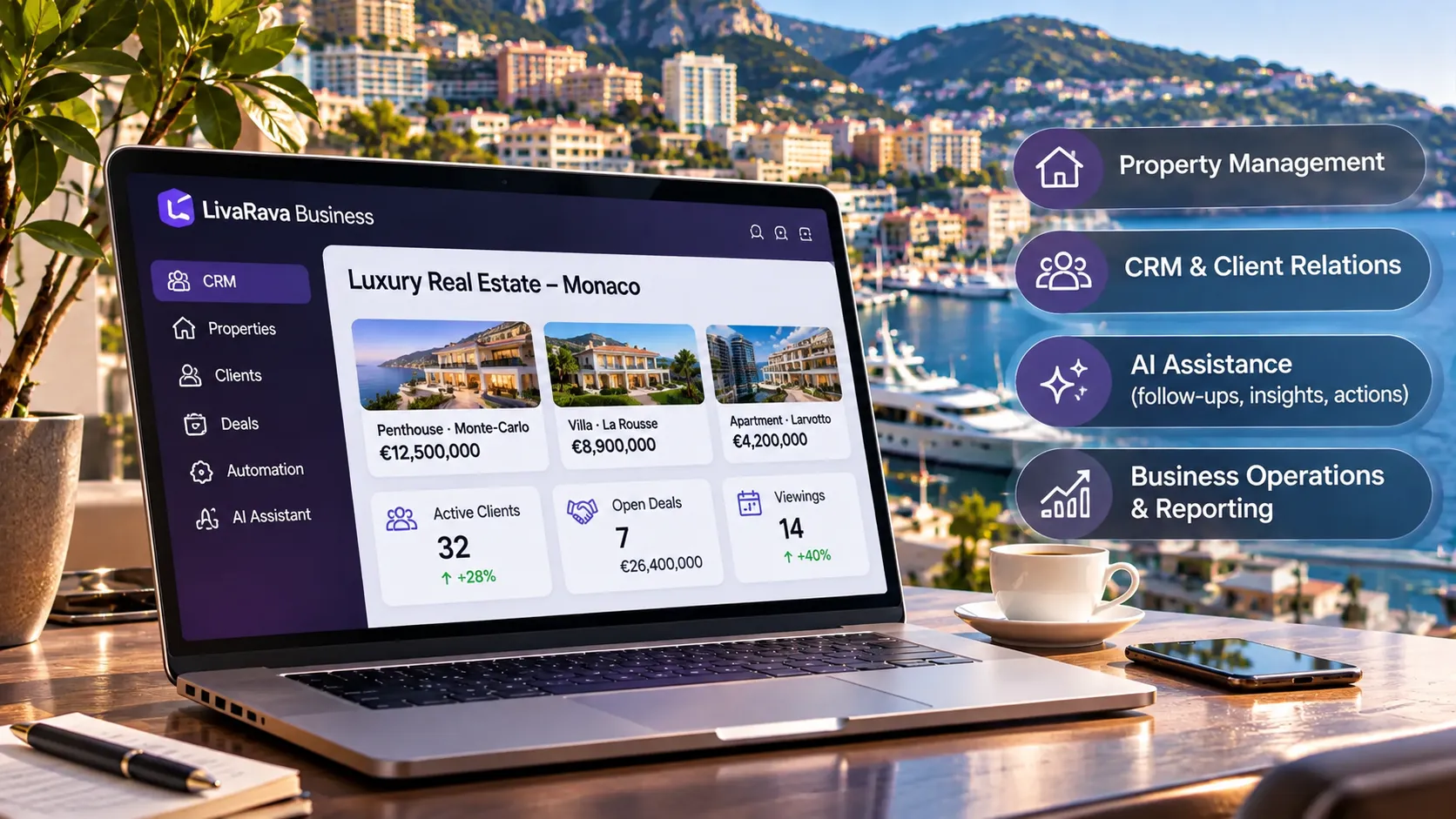
What connects Roomlr and this project isn't their size or business model.
At Roomlr, the challenge was scale. In Monaco, it's operational precision, confidentiality, and valuable customer relationships.
Both require thoughtful architecture, reliable information, and an understanding of how people actually work.
And the economics can be compelling. As illustrated earlier, a single €3 million transaction with a 3% commission represents €90,000 in potential commission revenue.
If a connected CRM and AI assistant helps an agency preserve even one transaction that would otherwise have been lost, the financial benefit could exceed the cost of the solution many times over — potentially by tens or even hundreds of times, depending on the transaction value, implementation cost, and circumstances.
This isn't a guaranteed return. But it illustrates why preventing missed opportunities can be far more valuable than simply reducing administrative expenses.
Don't wait for the next expensive opportunity to slip away. Discover how an AI-powered assistant could support your real estate agency.
How We Approach Real Estate Business Automation
At LivaRava, we don't believe every business problem requires another application.
And adding AI to an inefficient process doesn't automatically make it efficient.
Our approach starts with the business.
Where are opportunities being lost? Which actions are delayed? What information is missing when employees need to make decisions? Which processes create unnecessary complexity?
Depending on the situation, the solution may involve:
- Real Estate CRM: Managing leads, customers, activities, and business relationships.
- Communication Integrations: Connecting email, WhatsApp, Telegram, Slack, and other supported channels.
- Calendar Synchronization: Coordinating appointments across Google, Microsoft, and Apple calendars.
- Property Software Integrations: Connecting ImmoToolBox and other real estate systems through available interfaces.
- Connected Business Data: Making relevant information available across applications.
- Workflow Automation: Reducing repetitive work and improving operational consistency.
- AI-Powered Assistance: Supporting timely follow-ups, access to business knowledge, and better-informed decisions.
- Access Management: Designing appropriate controls for confidential business information.
Our approach is simple: Identify → Analyse → Decide → Act.
First, understand the problem and its financial impact. Then choose the solution that makes practical and business sense.
The Most Important Question Is What to Fix First
Real estate agencies don't necessarily need more technology. They need technology that helps them operate more effectively.
If customer inquiries are being missed, improve lead management.
If important follow-ups depend on individual memory, introduce better tracking and reminders.
If property and customer information is scattered across applications, connect the relevant systems.
If sensitive client information is distributed across personal accounts, improve access management and communication processes.
And if you're considering AI, give it access to useful information, clearly defined responsibilities, and appropriate workflows.
The best automation project isn't the one with the most impressive technology. It's the one that solves an expensive business problem.
After more than a decade working with real estate technology, I'm convinced that sustainable improvement starts with understanding the business, not choosing the next software tool.
Let's Find Your Most Expensive Bottleneck
If you manage a real estate agency and recognize some of these challenges, I'd be interested in understanding your situation.
We can review your existing processes, identify where opportunities or resources may be lost, and discuss whether CRM, ImmoToolBox integrations, AI assistance, or workflow automation could make a meaningful difference.
If you'd like to see the technology in action, you can request a demonstration. If you're still evaluating your options, we can start by identifying your most important business challenge.
The goal isn't to introduce more technology into your agency. It's to help you protect valuable opportunities and grow more efficiently.